OMTEX AD 2

Showing posts with label 3. Show all posts

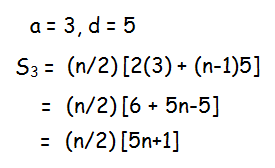
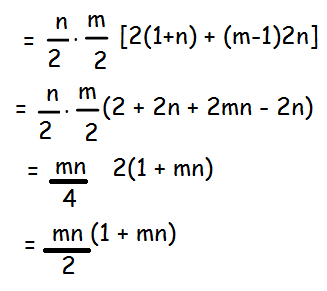
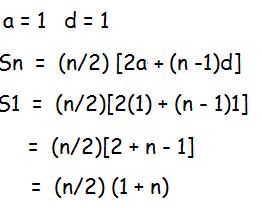
If S1, S2, S3,....Sm are the sums of n terms of m A.P.’s whose first terms are 1,2, 3,...m and whose common differences are 1, 3, 5,..., (2m -1) respectively, then show that S1 + S2 + S3 +............Sm = (mn/2)(1 + mn)

If S1, S2, S3,....Sm are the sums of n terms of m A.P.’s whose first terms are 1,2, 3,...m and whose common differences are 1, 3, 5,..., (2m -1) respectively, then show that S1 + S2 + S3 +............Sm  = (mn/2)(1 + mn)
Solution :
n = [(l-a)/d] + 1
 n  = [((2mn - n + 1) - (1 + n))/2n] + 1
 n  = [(2mn - n + 1 - 1 - n)/2n] + 1
n = [(2mn - 2n)/2n] + 1
n = (m - 1) + 1
n = m
 S1 + S2 + S3 +............Sm  
Hence proved.

Question 3: Check whether the relation R defined in the set {1, 2, 3, 4, 5, 6} as R = {(a, b): b = a + 1} is reflexive, symmetric or transitive. Chapter 1 - Relations And Functions

Chapter 1 - Relations And FunctionsNCERT Solutions for Class 12 Science Math

Question 3:

Check whether the relation R defined in the set {1, 2, 3, 4, 5, 6} asR = {(ab): b = a + 1} is reflexive, symmetric or transitive.

ANSWER:

Let A = {1, 2, 3, 4, 5, 6}.
A relation R is defined on set A as:
R = {(ab): b = a + 1}
∴R = {(1, 2), (2, 3), (3, 4), (4, 5), (5, 6)}
We can find (aa) ∉ R, where ∈ A.
For instance, 
(1, 1), (2, 2), (3, 3), (4, 4), (5, 5), (6, 6) ∉ R
∴R is not reflexive.
It can be observed that (1, 2) ∈ R, but (2, 1) ∉ R.
∴R is not symmetric.
Now, (1, 2), (2, 3) ∈ R
But, 
(1, 3) ∉ R
∴R is not transitive 
Hence, R is neither reflexive, nor symmetric, nor transitive.

For A = {-3,-1,0,4,6,8,10} B = {-1,-2,3,4,5,6} and C = {-1,2,3,4,5,7},show that (i) A U (B ∩ C) = (A U B) ∩ (A U C) (ii) A ∩ (B U C) = (A ∩ B) U (A ∩ C)

(11) For A = {-3,-1,0,4,6,8,10} B = {-1,-2,3,4,5,6} and C = {-1,2,3,4,5,7},show that
(i) A U (B ∩ C) = (A U B) ∩ (A U C)
(ii) A ∩ (B U C) = (A ∩ B) U (A ∩ C)
(iii) Verify using Venn diagrams
Solution:
(i) A U (B ∩ C) = (A U B) ∩ (A U C)
L.H.S
A U (B ∩ C)
(B ∩ C) = {-1,-2,3,4,5,6} ∩ {-1,2,3,4,5,7}
       = {-1,3,4,5}
A U (B ∩ C) = {-3,-1,0,4,6,8,10} U {-1,3,4,5}
            = {-3,-1,0,3,4,5,6,8,10}  --- (1)
R.H.S
(A U B) ∩ (A U C)
(A U B) = {-3,-1,0,4,6,8,10} U {-1,-2,3,4,5,6}
        = {-3,-2,-1,0,3,4,5,6,8,10}
(A U C) = {-3,-1,0,4,6,8,10} U {-1,2,3,4,5,7}
       = {-3,-1,0,2,3,4,5,6,7,8,10}
(AUB)∩(AUC)={-3,-2,-1,0,3,4,5,6,8,10} ∩ {-3,-1,0,2,3,4,5,6,7,8,10}
             = {-3,-1,0,3,4,5,6,8,10}  --- (2)
(1) = (2)
A U (B ∩ C) = (A U B) ∩ (A U C)
Hence proved


(ii) A ∩ (B U C) = (A ∩ B) U (A ∩ C)
A = {-3,-1,0,4,6,8,10} B = {-1,-2,3,4,5,6} and C = {-1,2,3,4,5,7}
L.H.S
(B U C) = {-1,-2,3,4,5,6} U {-1,2,3,4,5,7}
       = {-2,-1,2,3,4,5,6,7}
A ∩ (B U C) = {-3,-1,0,4,6,8,10} ∩ {-2,-1,2,3,4,5,6,7}
            = {-1,4,6} ---- (1)
R.H.S
(A ∩ B) = {-3,-1,0,4,6,8,10} ∩ {-1,-2,3,4,5,6}
       = {-1,4,6}
(A ∩ C) = {-3,-1,0,4,6,8,10} ∩ {-1,2,3,4,5,7}
       = {-1,4}
(A ∩ B) U (A ∩ C) = {-1,4,6} U {-1,4}
                    = {-1,4,6} ---- (2)
(1) = (2)
A ∩ (B U C) = (A ∩ B) U (A ∩ C)

Hence proved
Verify the commutative property of set intersection for A = {l,m,n,o,2,3,4,7} and B = {2,5,3,-2,m,n,o,p}

Question 6
Verify the commutative property of set intersection for A = {l,m,n,o,2,3,4,7} and B = {2,5,3,-2,m,n,o,p}
Solution:
commutative property of set intersection
A ⋂ B = B ⋂ A
A ⋂ B = {l,m,n,o,2,3,4,7} ⋂ {2,5,3,-2,m,n,o,p}
     = {m,n,o}  --- (1)
B ⋂ A = {2,5,3,-2,m,n,o,p} ⋂ {l,m,n,o,2,3,4,7}
     = {m,n,o}  --- (2)

(1) = (2)

Given A = {a,x,y,r,s}, B = {1,3,5,7,-10},verify the commutative property of set union.

Question 5
Given A = {a,x,y,r,s}, B = {1,3,5,7,-10},verify the commutative property of set union.
Solution:
commutative property of set union
A U B = B U A
A U B = {a,x,y,r,s} U {1,3,5,7,-10}
    =  {a,x,y,r,s,1,3,5,7,-10}   ------ (1)
B U A = {1,3,5,7,-10} U {a,x,y,r,s}
    =  {a,x,y,r,s,1,3,5,7,-10}  ------ (2)

(1) = (2)

If A = {4, 6, 7, 8, 9} , B = {2, 4, 6} and C = {1, 2, 3, 4, 5, 6}, then find (i) A U (B ∩ C) (ii) A ∩ (B U C) (iii) A \ (C \ B)

Question 4 :
If A = {4, 6, 7, 8, 9} , B = {2, 4, 6} and C = {1, 2, 3, 4, 5, 6}, then find
(i) A U (B ∩ C) (ii) A ∩ (B U C)    (iii) A \ (C \ B)
Solution :
(i) A U (B ∩ C)
(B ∩ C) = {2, 4, 6} ∩ {1, 2, 3, 4, 5, 6}
 = {2, 4, 6}
A U (B ∩ C) = {4, 6, 7, 8, 9} U {2, 4, 6}
 = {2, 4, 6, 7, 8, 9}
(ii) A ∩ (B U C)
(B U C) = {2 ,4, 6} U {1, 2, 3, 4, 5, 6}
       = {1, 2, 3, 4, 5, 6}
A ∩ (B U C) = {4, 6, 7, 8, 9} ∩ {1, 2, 3, 4, 5, 6}
            = {4, 6}
(iii) A \ (C \ B)
C \ B = {1, 2, 3, 4, 5, 6} \ {2, 4, 6}
    = {1, 3, 5}
A \ (C \ B) = {4, 6, 7, 8, 9} \ {1, 3, 5}

           = {4, 6, 7, 8, 9}